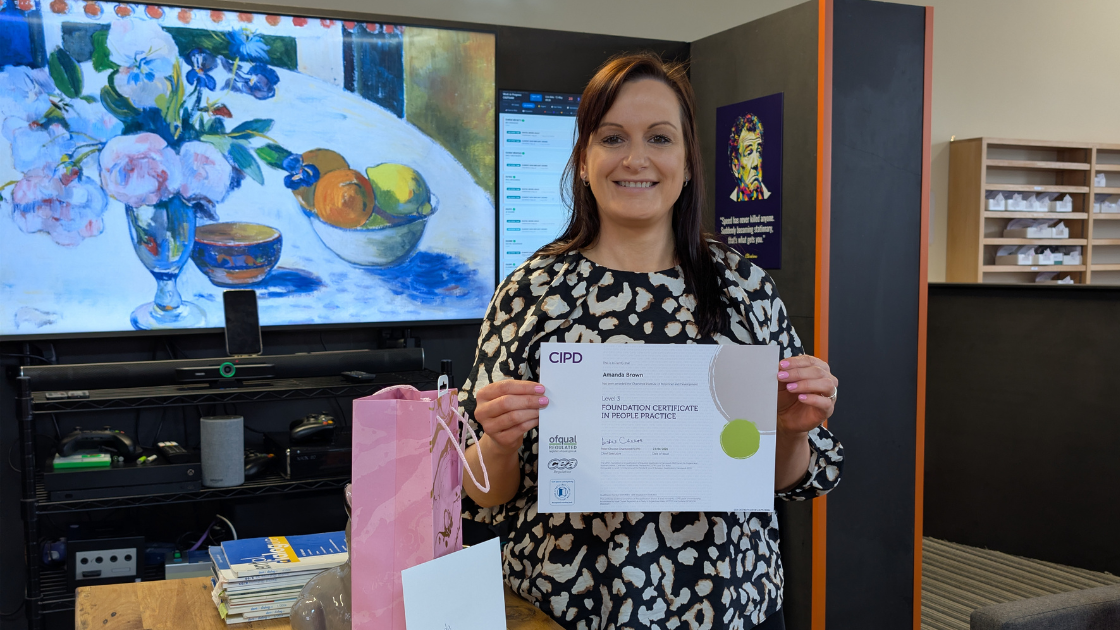
Amanda Phillips, our Laboratory Manager, has just completed her Foundation Certificate in People Practice with the CIPD. She did it across a year in which she ran our lab floor through one of the busiest stretches we've ever had, helped onboard new scanner protocols, and planned a wedding. The wedding is why she's Phillips now and not Brown. Everything else is why we're writing this.
Most of the news in our industry at the moment is about software: AI dental CAD, generative design, automated nesting, and scanner integrations. The press releases write themselves, and most of them sound the same. This isn't that kind of update. It's a different headline, and one that is just as important. If not more so.
The Foundation Certificate in People Practice is the entry-level qualification of the Chartered Institute of Personnel and Development, the UK's professional body for HR and people management. It covers employee experience, performance, organisational culture, the legal mechanics of managing people, and what the CIPD calls evidence-based people practice. It is a serious credential for anyone whose job is to lead a team well.
Amanda runs our lab floor. She holds the operational overview across every department, makes sure cases keep moving at the right pace through the right hands, supports the team day to day, and works closely with Melanie on client liaison and case tracking. The technical specialists are deep experts in their disciplines. Amanda holds the structure that keeps them focused on the case as a whole without losing sight of their work.
So why a people-practice qualification rather than something more operational? Because the harder problems in a busy lab are rarely about machines or materials. They're about how a team of specialists works together under pressure, how a new starter is brought up to speed, how standards hold when a department is short-handed, how feedback is given, and how morale gets protected through a long week. Those are people problems, and the lab manager who's been trained to think about them properly is the manager who keeps the floor running well enough that the technical experts can stay focused on the cases in front of them.
The industry conversation right now is dominated by automation. AI dental CAD is real and improving fast. Auto-nesting is real. Generative design for splints and trays is real. We use these tools, we test new ones regularly, and we expect them to handle more of the repetitive technical work over the next few years. That's a good thing, broadly speaking. Anything that takes routine work off skilled hands is worth taking seriously.
None of those tools replaces the judgment that sits behind the scenes. The clinical reasoning, or years of pattern recognition, that tells a senior technician when a case needs a second look. The communication with surgeons that turns a tricky case into a good outcome. That layer of the work doesn't automate. As routine work shifts to software, interpretive work becomes a larger share of what a lab actually does.
Which is where Amanda comes in. The lab that runs well at the interpretive end of the work needs a team that's been properly developed, supported under pressure, and led with a steady hand. The work that's left when automation takes the routine away is more judgment-led, more collaborative, more demanding of the people doing it. The manager who keeps that environment running well is the manager who's been trained to think about people, not just process.
For the kind of lab we want to be, technology answers specific questions, and people answer another set. The lab that runs both layers well is the lab that the better surgeons end up working with over time. That's the bet we're making, and the qualifications we invest in reflect it.
There's a useful analogy from a different industry. When self-checkout arrived in supermarkets, the prediction was the death of the cashier. What actually happened was that cashier work became something else. The good ones now do the things the machines can't. Solving the awkward problem at the till. Helping the customer who's struggling. Holding the store's tone of voice for the five minutes a shopper is in the store. The role got smaller in volume and larger in skill.
Clinical dental technology is doing something similar to what a dental lab does. More of the floor will look automated as the technology develops. The people on it will be doing more interpretive, judgment-led work, not less. A lab's edge will sit in how well it develops them.
Amanda has put a lot of evenings and weekends into this qualification over the last year, on top of everything else she had on. We're very proud of her and very glad to have her oversee the running of our lab.