30 years in the dental space have left me with one habit I have never shaken. In whatever case is before me, I want to know where the material originated, whose hands it passed through, and what will happen if someone contacts me about it in three years' time. That habit predates the 3D printers and the digital workflows. It comes from the simple fact that everything we create ends up inside a person and stays there.
I am writing it because an advert appeared in my feed offering UK practices their lab work at “half price”, and I went looking for the paperwork behind it. What I found is worth any practice principal's 10 minutes, whoever they send their work to.
I want to clarify my position. Nexus specialises in implant and complex restorative cases. The platforms advertising crowns at 50-60% off are not competing for that work and have shown no interest in doing so. I am not writing this to defend a price list.
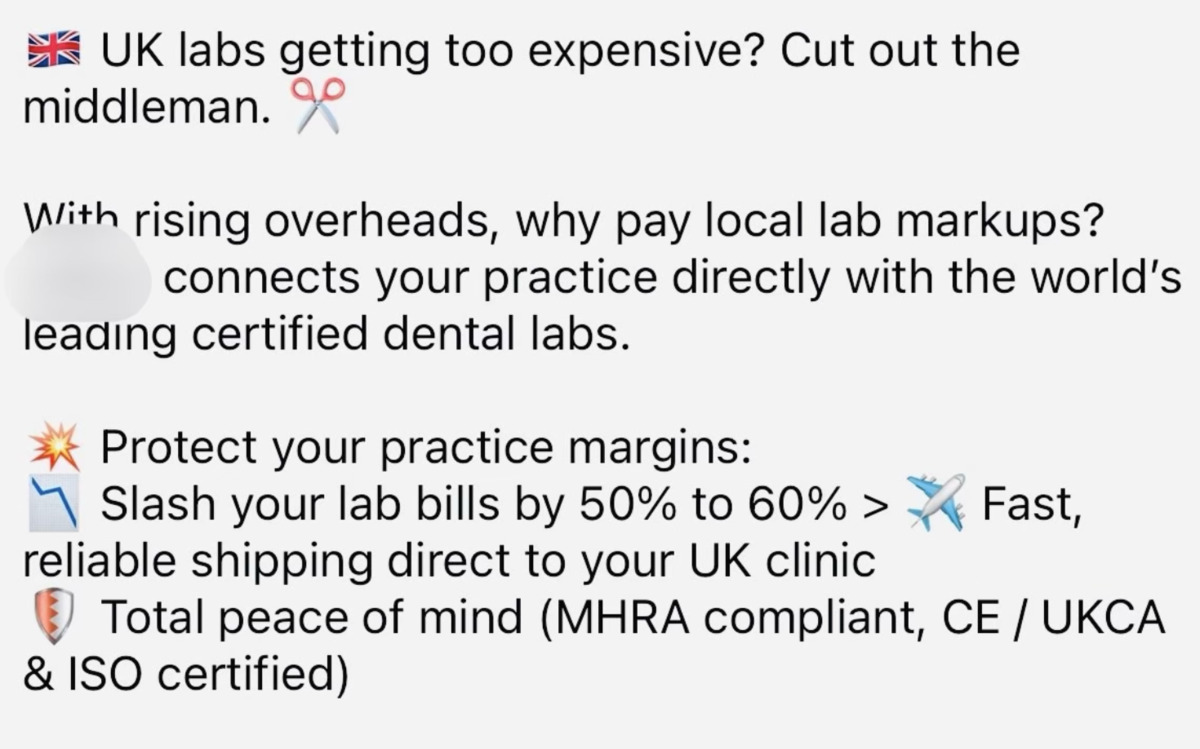
Their pitch is straightforward. Overheads are up, lab bills are a visible item on the P&L, and a platform will connect the practice directly with “certified laboratories abroad.”
What really caught my attention was that beneath the ad sat a comment thread in which dentists and technicians repeatedly asked for details that the advert had not provided.
One of them summed it up in five words: fifty to sixty per cent of what? The explanation was that the savings are measured against average prices usually charged by local laboratories in the UK and Europe. A percentage compared to a figure nobody will name is not a number you can use to make an outsourcing decision.
A laboratory invoice is mostly for people. Materials matter, and the equipment bill is substantial once you are running milling machines, printers, and sintering furnaces. The largest part of the cost for a medical device is the time a trained, skilled technician spends on it. Therefore, a 50-60% reduction must come from saving time, reducing material costs, or both.
There is an additional constraint. The platform sits between the practice and the manufacturing laboratory and needs to generate revenue to provide this service. The underlying manufacturing cost must decrease by more than the headline saving to allow space for the platform's margin as well. Someone in the thread clearly pointed out that an intermediary is, by definition, an extra layer of cost and friction, and the response was that the platform justifies its existence through efficiency rather than markup.
Of course, efficiency is real, and we have spent years removing friction from our own workflows. What it reduces is the cost of moving work around: file transfers, scheduling, chasing, and invoicing. Think of a set of an architect's drawings. Sending them to the builder faster and tracking them more effectively are genuinely valuable; however, they do nothing whatsoever to reduce the time it takes to lay the bricks.
Nobody has yet explained which of those line items absorbs a 60% cut.
Here is what stopped me: the advert lists MHRA compliance, CE and UKCA marking, and ISO certification together as a single reassurance.
Custom-made dental devices are not CE- or UKCA-marked, and this is intentional rather than an oversight. A crown crafted for a specific patient cannot undergo type-testing like a batch of syringes, so the legislation takes a different approach entirely.
In Great Britain, the main regulation is the Medical Devices Regulations 2002 (SI 2002/618), as amended. Regulation 13 describes the procedures for applying a mark to a general medical device. Custom-made devices are excluded from this. They are covered separately under regulation 15, which bans the supply of a custom-made device unless its manufacturer, or their UK Responsible Person, has prepared a statement with the information required by Sections 1, 2 and 2.1 of Annex VIII, and has committed to keeping the design and manufacturing documentation available for inspection.
That statement is the mechanism. It carries the manufacturer's identity, device-identifying data, and confirmation that it was manufactured for a named patient in accordance with a prescription. The paperwork performs the same function as a conformity mark elsewhere.
An advert offering CE and UKCA marking as proof of safety for a custom appliance describes a regime that does not apply to the product it is selling. The practice is asking people to trust this operation's control over regulation. The advert is the first piece of evidence available on that matter, and it does not hold up under a single search.
There is a second distinction hidden in that advert, and I see it overlooked constantly.
Registering with the MHRA is a notification. You inform the agency of your existence and what you produce, pay the fee, and are listed in a database. Manufacturers based outside the UK cannot do this directly and must appoint a single UK Responsible Person to do so on their behalf. The MHRA is unusually clear about the limits of this process, stating in its guidance that registration does not constitute any form of accreditation, certification, approval, or endorsement by the agency. No one visited or requested material certificates from a case last March.
An audited quality system is a different animal. DAMAS, the Dental Appliance Manufacturers Audit Scheme, sends a third-party assessor to the premises to examine samples of actual records and judge whether the system you describe is the system you operate.
Nonconformities must be closed within 30 days. If the assessor concludes on the day that the underlying systems are absent, they suspend the assessment. Registration lapses without a further assessment every year.
This is the difference between a passport and a driving test. One confirms who you are, and the other confirms that somebody watched you do the thing.
What the current specification asks for is worth spelling out, because it maps almost exactly to the questions in that comment thread. Issue 8, which came into force for audits on 25 May 2020, requires patient contact materials to be traceable back to a purchase order, so the laboratory can tell you which batch of zirconia went into a specific patient.
Records are kept for 10 years. There must be a documented risk management system and a post-market surveillance process that collects and evaluates what happens to appliances after they leave the building. Approval for manufacture has to be signed off by a dental technician. The statement accompanying the device must include the name and address of the manufacturer and of every manufacturing site involved. The patient statement requirement was tightened at the same time, so it is now available to the patient rather than on request.
Read that penultimate requirement again with a routing (middleman) platform in mind. Every manufacturing site, named and addressed, is included in the statement that reaches the patient.
Which brings me back to the thread. A dentist asked whether the platform provides the MHRA number of the manufacturing laboratory and a copy of its DAMAS certificate. That is a precise question with a yes-or-no answer. The reply described partner laboratories with extensive experience in international markets, able to supply the documentation required by the destination market, alongside a commitment to strengthening the partner qualification process.
I have read enough marketing copy in my time to recognise what that paragraph is doing. It is answering a different question, warmly. A yes would have been one word. A no would have been one word. What arrived instead was three sentences about ambition.
Geography is no obstacle to participation either. The DAMAS register includes laboratories in Ireland, Spain, and the United States. The scheme is overseen by DAMAS International, and any laboratory wishing to demonstrate its systems to a British prescriber has a pathway to do so, and many have already taken it.
So the question remains as originally asked: which annually audited quality system does the site that will actually produce this device adhere to, who assessed it, and when? ISO 13485 would provide an answer. The same applies to DAMAS or any certification bearing an assessor's name and date. What should give a practice pause is a reply that avoids the question altogether.
Ours is a matter of public record, and anyone can download it from the DAMAS register without asking us first. That is the standard the question deserves.
This is the part I would want any practice principal to sit with, because two separate bodies of rule converge on the prescriber, and they do so from different directions.
The first is professional. The GDC's guidance on commissioning and manufacturing dental appliances has a section written for exactly this situation, and the word it uses is "agent." A registrant who subcontracts manufacturing or uses a laboratory or agent to source appliances from outside the UK assumes additional responsibilities.
Chief among them is a duty to ensure that the manufacturer or its authorised representative has complied with all relevant obligations under the medical device regulations. The same document states that compliance with those regulations is a legal requirement and that failing to comply is a criminal offence, and it sits beneath Standard 1.9 of Standards for the Dental Team, which requires registrants to learn about the laws affecting their work and follow them.
Sit with the concept of that duty for a moment. It is a duty to ensure, which is an active verb. It is not discharged by a supplier telling you they are compliant, any more than a builder's assurance that the wiring is fine relieves you of the need to obtain a certificate. You are expected to have checked and to be able to demonstrate what you checked.
The second aspect is civil. The Consumer Protection Act 1987 imposes strict liability for damage caused by a defective product. Section 2(2) specifies who bears this liability: the producer, anyone who presents themselves as the producer by marking or signing the product, and any person importing the product into the United Kingdom in the course of business for supply to another. That third limb previously read "into a member State" and was amended on 31 December 2020 to read "into the United Kingdom," closing a gap caused by Brexit. Strict liability means the claimant need not prove negligence; they need only show that a defect existed and that harm occurred.
In fairness, the scope of that Act is narrower than it initially appears. It covers death, personal injury, and damage to private property, but excludes damage to the product itself and pure economic loss. A device that simply fits poorly is a commercial issue between you and your supplier rather than a matter covered by the Act. The Act is relevant when something goes seriously wrong, which is precisely when you need to know exactly who is responsible.
Combine the two ideas, and the situation is this: The platform model does not eliminate the verification process from the practice. Instead, it introduces a third party between the practice and the required information, while preserving the professional responsibility and, quite possibly, the importer's liability exactly as they were. The invoice decreases, the risk increases, and the second part of that trade never appears on the quote. It acts more like an insurance excess. You agree to it when the premium seems attractive, and you find out its true value only when you make a claim.
There is a further question here that I am not qualified to answer, which is precisely why I would want a practice principal to ask it of somebody who is.
Most UK dental indemnity is discretionary. The three mutual defence organisations that cover the bulk of the profession, Dental Protection, the DDU and MDDUS, all operate on that basis, and it has served dentistry well for a very long time. The mechanism is worth understanding, though. A discretionary organisation considers whether to assist you rather than being contractually bound to do so. While refusal is rare, the right you hold is a right to be considered. Contractual policies work differently and are available from several providers.
Discretion gets exercised against the background of how you conducted yourself. So the question I would put is this: if a patient brings a claim arising from an appliance sourced through an overseas platform, and the GDC's position is that you had taken on additional responsibilities and a duty to ensure the manufacturer's compliance, what evidence would you be able to produce that you discharged it? A file note recording that the platform assured you would be thin. A named laboratory, an MHRA number and a current audit certificate would be considerably better.
There is a second question underneath it. Professional indemnity generally responds to claims arising from the practice of dentistry. A strict liability claim under the Consumer Protection Act brought against you as the importer of a defective product is a different creature, and it may be a matter for practice or product liability cover rather than clinical indemnity. I do not know how any particular provider treats it, and I would not guess.
It is rather like the approved lock clause on a household policy. Nobody refuses your claim because you were burgled. The awkwardness comes from what you did, or did not do, beforehand.
I have just spent a thousand words on regulations, so it is worth stopping to say what all of that machinery is for.
We create devices that go inside the human body and remain there.
These devices operate in a warm, damp, and heavily loaded environment around the clock for a decade or more. There is no other manufactured object I can think of that a person is required to accept under those conditions.
I do not say this to appear virtuous. I run a business and have sat late at night with a spreadsheet, trying to find ways to cut costs, just like any practice principal. That pressure is very real, and there is nothing shameful about responding to it. Most of the savings accessible to a laboratory or dental practice are genuinely sensible: better scheduling, less waste, fewer unnecessary journeys, and tighter purchasing.
What makes this particular decision different is that the savings come from the part of the process that decides what ends up in someone's mouth. The information needed to judge whether that is safe has been placed on the other side of an intermediary who will not answer direct questions about it.
It's easy for that to slip out of focus when the invoice is in front of you and the month has been tough. I keep one thought close: the person who ends up facing the consequences of this decision is not in the room when it's made.
Let me set the regulatory questions aside for now and think of this solely as maths.
Imagine a crown costs you £60 instead of £180. Over a hundred units a year, that amounts to £12,000 retained, which is a significant figure for any practice. Now, consider the cost of a remake. An hour of surgery time has a known expense, and a remake involves that hour twice; once to fit the unsuccessful appliance and once to fit the successful one. Include a fortnight of shipping in each direction, a patient who has now been in the chair three times for a single tooth, and the difficult conversations that go along with it.
You don't need a high remake rate for the sums to invert. What you need is a way to know the remake rate before you commit, and that figure is hard to obtain when manufacturing takes place thousands of miles away through a party you have never met.
I would hold my own laboratory to every one of these, and I would expect any practice to ask them of us without apology.
None of these questions is hostile, and a well-run laboratory anywhere in the world should be able to answer all seven within an afternoon. If the answers are slow to come, that in itself provides information.
I am not suggesting that manufacturing must occur within 20 miles of the surgery, and I have seen excellent work come from laboratories far from Ripon. My concern is more specific. A custom appliance has a chain of accountability that runs from the technician's hands to the patient's mouth, and this chain must remain visible and intact for any regulation to be meaningful. When a platform is inserted into the middle of this chain, the practice needs to know exactly where each link now stands because if the chain breaks, both the regulator and the patient will first look at the person who signed the prescription.
The dentists and technicians in that comment thread were asking for the name of a laboratory, an MHRA number, and a quality certificate. Those are the right questions, and they deserved better answers than they received, because behind each of them is someone sitting in a chair, waiting for something permanent to be done to them.