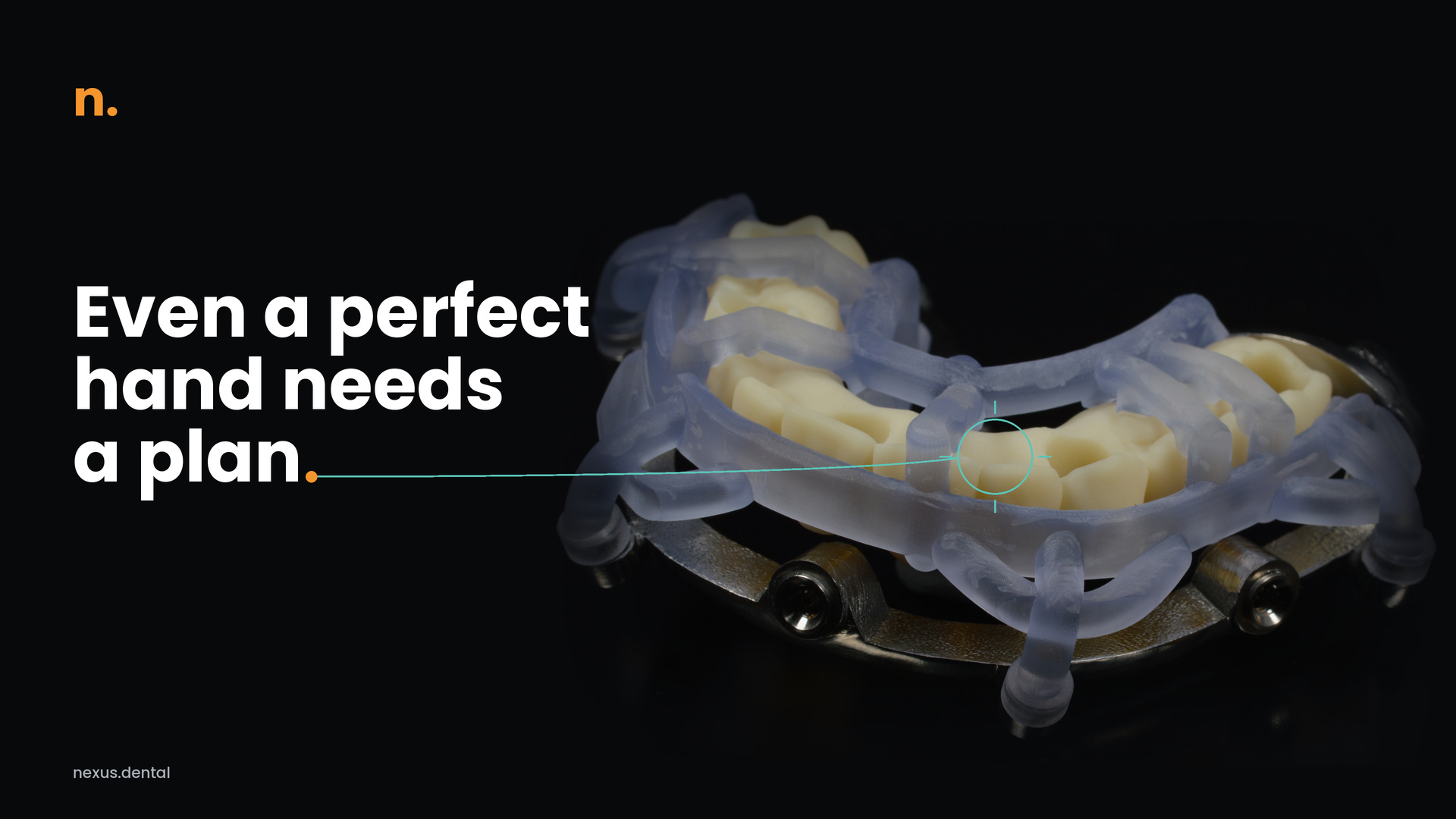
Even a perfect hand needs a plan. Autonomous implant robots have reached Europe, and they make the clearest case yet for planning that starts from the final tooth.
By Steve Campbell, RDT FCGDent, Managing Director and Clinical Lead, Nexus Dental Laboratory. Published November 2026
Robotic dental implant surgery uses a robotic arm to prepare the implant site and place the implant according to a digital plan, under a surgeon's supervision. The leading autonomous system, Yakebot, is CE-marked and now in clinical use in Europe. Robots improve how faithfully a plan is followed. The plan itself, built backwards from the final restoration, still determines the clinical outcome.
Robotic computer-assisted implant surgery (rCAIS) uses a robotic arm to carry out a digital implant plan in the patient's mouth. It joins two established approaches. In static computer-assisted implant surgery (sCAIS), a 3D-printed surgical guide directs the drill. In dynamic navigation (dCAIS), cameras track the drill against the plan in real time.
Implant robots vary in how much they do autonomously. Haptic systems keep the surgeon's hand on the handpiece and physically limit its movement. Task-autonomous systems such as Yakebot move the arm independently, preparing the site and placing the implant while the surgeon directs the procedure through foot pedals (Liu et al., 2024).
The first autonomous robotic implant placement took place in China in 2017 (Luo et al., 2026). China's National Medical Products Administration authorised Yakebot in 2021 (Scientific Reports, 2025), and it is CE-marked under the EU Medical Device Regulation (Jorba-Garcia et al., 2026). In October 2026, the dental faculty of the International University of Catalonia in Barcelona used it to place an implant in a patient, the first autonomous robotic implant surgery in Catalonia (B-One Dental, 2026). Footage of the robot working on a mannequin head has since circulated widely, captioned as proof that robot dentists have arrived.
The robotic workflow begins exactly where guided surgery begins. The surgeon takes a CBCT scan and an intraoral scan, then plans the implant's position, angle, and depth in software, accounting for the planned prosthesis and the anatomy.
On the day of surgery, a patient-specific reference template made before surgery is fixed in the mouth and carries markers that the robot's cameras track. After calibration and registration, the robotic arm moves to the site, prepares the osteotomy in stages and places the implant. The surgeon monitors drilling position, depth, orientation and force throughout, and can adjust the plan as the case requires (Luo et al., 2026).
On current evidence, robots place implants slightly closer to the plan, by fractions of a millimetre, and guided surgery remains comfortably within clinical tolerance. The most recent randomised trial compared the two directly in single posterior implants:
| Measure | Fully guided surgery (sCAIS) | Robotic surgery (rCAIS) |
|---|---|---|
| Deviation at implant platform | 1.02 mm | 0.70 mm |
| Deviation at implant apex | 1.11 mm | 0.75 mm |
| Angular deviation | 2.38 degrees | 1.20 degrees |
| Total surgical time | 24 minutes | 50 minutes |
| Patient-reported discomfort (0 to 10) | 1.67 | 3.00 |
Source: Luo et al., Clinical Oral Implants Research, 2026. 36 patients, 40 implants.
The authors concluded that both methods achieved clinically acceptable accuracy, and that guided surgery offered better surgical access, shorter procedures and a better patient experience. The main source of discomfort in the robotic group was keeping the mouth open, since the arm needs sustained wide opening in posterior sites. A 2026 systematic review of head-to-head studies reached the same conclusion on accuracy (Wang et al., 2026).
For the surgeon, the practical question is what an extra fraction of a millimetre is worth against chair time, set-up and patient comfort. In many cases, a well-planned surgical guide answers that question very well.
It needs its own custom device. Robotic guidance takes over the drilling step, but published Yakebot workflows still rely on a patient-specific device made from the plan to link the patient to the software. In the randomised trial above, this was a reference template fixed to the adjacent teeth with resin (Luo et al., 2026). In a sinus-lift study, a positioning guide with registration points was designed and 3D printed from the surgical plan (PMC13483154).
Every route from plan to mouth, printed guide or robotic arm, relies on a precisely made device built to the plan. Making patient-specific devices to a plan is a specialist dental laboratory's core competence.
An implant is placed once and restored for decades. Its position governs the emergence profile, screw access, how load travels through the crown, and how soft tissue settles around it. A small discrepancy can often be managed with a custom abutment. A larger one shapes every restorative decision that follows.
The International Team for Implantology's consensus states that guided surgery is an adjunct to appropriate diagnosis and treatment planning and should always be prosthetically driven (ITI).
Good placement starts with the tooth the patient will eventually bite on and works backwards into the bone.
Milling machines transformed dental laboratories. A mill reproduces a design to within microns, case after case, and cuts whatever file it is given. Once fabrication became reliable, the value moved into the design and the judgment of the person who drew it. Implant robots are milling machines for bone.
That's why a robot that lands an implant 0.3 mm closer to the plan delivers its full value when the plan itself is right.
AI planning tools are improving quickly. A 2026 cohort study in the aesthetic anterior maxilla found that AI-generated proposals closely matched expert virtual planning and were produced around 40% faster. The authors concluded that the approach maintains clinically acceptable outcomes under clinician supervision (Clinical Oral Implants Research, 2026).
Supervision is where experience earns its keep. A fast first draft gives the clinician and the restorative team more time for the judgement calls that shape the result: the smile line, the bite, the soft tissue and the restoration the patient will live with.
The surgeon examines the patient, makes the diagnosis and signs off on the plan. That plan grows stronger when the restorative team contributes from the start, because those who design and build implant restorations every day see most clearly how position shapes the finished tooth.
From the bench, an ideal implant position is one that lets the final restoration be made cleanly: the fixture emerges where the crown needs it, with enough restorative space, a central or predictable screw-access path where appropriate, and contours that support the intended emergence profile. In practice, we are not simply looking for “bone that fits an implant”; we are checking whether the planned position will produce a restorable, maintainable, and aesthetic prosthesis.
Steve Campbell, RDT FCGDent, Managing Director, Nexus Dental Laboratory
Before an implant plan we co-plan with a surgeon is signed off, it passes 5 restorative questions:
The check applies equally whether the plan reaches the mouth through a surgical guide or a robotic arm.
Devices CE-marked under the EU Medical Device Regulation, including custom-made devices, can currently be placed on the Great Britain market until 30 June 2030 (RQA). In 2026, the MHRA consulted on recognising EU MDR devices indefinitely, noting that around 90% of medical devices used in Great Britain are CE-marked (GOV.UK).
A CE-marked implant robot therefore has a regulatory route into UK dentistry, and UK surgeons will judge its place against cost and training. As robots arrive, the planning principles above carry straight across.
Nexus Dental Laboratory is a specialist implant and complex restorative laboratory working with surgeons across the UK. We co-plan implant positions from the final restoration backwards and deliver each plan as a precision surgical guide, made with our own combination of workflow, technology, and materials.
We are an official Neoss implant planning and guide centre, and we plan in MGuide, coDiagnostiX and SMOP. The surgeon makes the clinical decision; we bring the restorative perspective and the device that delivers the plan into the mouth.
Planning an implant case? Send it to [email protected], and we will plan it with you, starting from the final restoration.
Current implant robots all work under a qualified surgeon, who prepares the plan in advance and supervises the robot throughout, with the ability to stop or adjust it at any point.
In a 2026 randomised trial of single posterior implants, robotic surgery averaged about 50 minutes, including around 12 minutes of calibration and registration. Fully guided surgery averaged about 24 minutes.
Yes. Static guided surgery is the most widely used form of computer-assisted implant surgery, and in the 2026 trial it achieved clinically acceptable accuracy with shorter procedures and a more comfortable patient experience.
It means deciding the implant position from the planned final restoration, then working backwards into the bone and checking the anatomy.